Financial Reporting and Analysis in a Modern FP&A Platform

Planning and reporting are based on the same data and lead to the same decisions. Yet they are often managed in separate systems.


The budget is complete. The forecast has been updated. Now it is time to analyse actuals, understand variances and decide on the next steps. For many controllers and FP&A teams, this means continuing the work in another system. Data is exported or reloaded into a BI tool, reports are rebuilt and analyses are supplemented with comments from across the organisation. When the forecast is updated again, the process starts all over. It is a way of working that many have come to accept as normal.

In short: Reporting works best when it is integrated with budgeting, forecasting and analysis. This allows the FP&A team to work with the same data throughout the entire process and move more quickly from an identified variance to an updated forecast, scenario or decision.

In this article you'll learn:

  • why reporting and planning should be connected
  • how FP&A and BI complement each other
  • how financial and operational KPIs can be analysed together
  • how reporting can be tailored to different audience

FP&A is one connected process – not several separate systems

Budgeting, forecasting, reporting and analysis are all parts of the same process. They rely on the same data and serve the same purpose – to provide the organisation with better insights for decision-making. Despite this, many companies still work across several different tools, continuously moving information between systems. The budget is prepared in one tool, reporting takes place in another and analyses are sometimes compiled in Excel or yet another solution.

Managing the different parts of the FP&A process in separate systems often results in significant time being spent on:

  • manual data transfers
  • waiting for reports to be updated
  • creating multiple versions of the same data
  • more administration and less time for analysis
  • a more time-consuming path from analysis to decision-making


What does reporting mean in FP&A?

Reporting in FP&A involves monitoring and analysing financial and operational performance against budgets and forecasts, identifying variances and providing insights for future decisions and planning.

Reporting is therefore not simply about reviewing what has already happened. It should also provide the basis for the next decision. When a controller identifies a variance, the analysis should be able to lead directly to the next step. Perhaps the forecast needs to be updated, a new scenario created or an assumption adjusted.

Reporting itself is rarely the problem. The challenge arises when planning, reporting and analysis take place in different systems and information constantly needs to be moved between them, resulting in an unnecessarily drawn-out process. This is why reporting is an integrated part of Planacy.

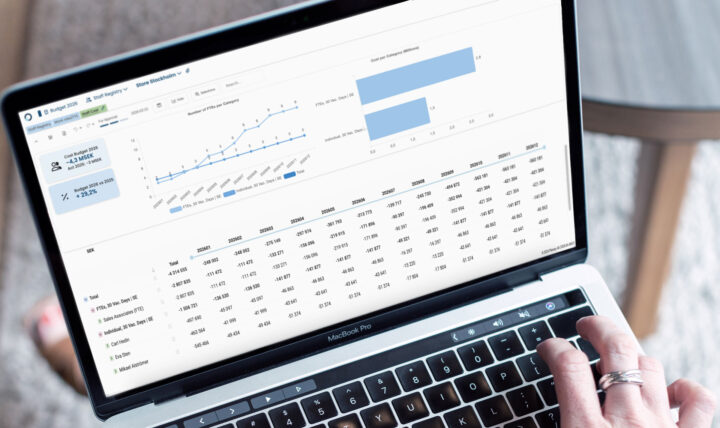
In Planacy, analysis, reporting and planning take place within the same platform, meaning that forecasts, actuals, scenarios and comments are already available in one place. When a forecast is updated, it becomes immediately available in reporting – without exports, reloading data or waiting for another system to update. This means less time needs to be spent on manual administration and more time can be dedicated to analysis and supporting the business. At the same time, the path from insight to action becomes significantly shorter, making it easier to work continuously with financial planning.

Planacy does not replace BI – the solutions complement each other

The fact that Planacy offers powerful reporting and analysis functionality does not mean that BI tools no longer have an important role to play. On the contrary, BI solutions are often particularly strong when it comes to analysing large volumes of data from multiple operational systems, creating operational dashboards and visualising information for a broad range of users across the organisation.

Planacy has a different focus. The platform is designed for budgeting, forecasting, scenarios and financial analysis, where planning and reporting are closely connected. By bringing these different elements together in the same solution, reporting becomes a natural part of the planning process rather than a separate task. When Planacy is used alongside a BI tool, the organisation gets the best of both worlds:

  • Planacy for budgeting, forecasting, scenarios and financial analysis
  • BI for broader business reporting and visualisation across multiple data sources

Rather than competing, the solutions complement each other.

Combine financial and operational KPIs in your reporting

Financial reports show what has happened. Operational KPIs help explain why. To provide better insights for decision-making, financial figures often need to be analysed alongside the organisation’s operational drivers.

For example, this could mean understanding how changes in customer numbers affect revenue or how production volumes affect manufacturing costs. In Planacy, financial and operational KPIs can be combined within the same report.

For example, you can monitor:

  • revenue and margins alongside customer numbers
  • staff costs alongside headcount
  • utilisation rates alongside financial performance
  • units produced alongside manufacturing costs
  • energy production alongside electricity prices


When financial and operational KPIs are presented together, it becomes easier to identify the drivers behind business performance and make better-informed decisions.

Tailor financial reports to different audiences

Reporting is not only about analysing numbers. It is also about communicating the right information to the right people. A controller, a budget owner and a board of directors rarely have the same information needs. Reporting therefore needs to be tailored to its audience while ensuring that everyone works from the same underlying data.

In Planacy, reports can be built using tables, charts, KPIs and dashboards tailored to different audiences. The same information can be presented in different ways depending on who the report is intended for, without having to duplicate data or manage multiple versions. This reduces the risk of version-control issues, simplifies governance and allows the FP&A function to spend less time on data quality and more time on analysis and supporting the business.


Reporting is part of continuous planning

The greatest benefit of reporting in Planacy is not simply the ability to create clear reports or dashboards. It is also about creating a more connected way of working.

When budgeting, forecasting, reporting and analysis are brought together in a single platform, many of the unnecessary interruptions caused by switching between processes and platforms disappear. As a result, insights from analysis can be translated more quickly into new forecasts and updated scenarios. This, in turn, allows the FP&A team to spend less time on administration and more time supporting the business with relevant insights and well-informed decisions. Reporting is therefore not the end of the FP&A process – it is the link between analysis and the next decision.

Financial reporting in FP&A involves monitoring actuals, analysing variances and comparing performance against budgets and forecasts to provide better insights for decision-making.

When reporting, budgeting, forecasting and analysis take place within the same platform, the FP&A team does not need to move data between different systems. This reduces administration and shortens the path from analysis to an updated forecast or a new decision.

An FP&A platform is designed for budgeting, forecasting, scenarios and financial analysis, connecting planning with reporting. BI tools are often particularly strong at analysing large volumes of data from multiple operational systems and creating broad dashboards and visualisations.

Not necessarily. An FP&A platform and a BI tool can complement each other, with the FP&A platform used for financial planning and analysis and BI used for broader business reporting and visualisation across multiple data sources.

Reporting shows actual performance, analysis helps explain variances and these insights can then be used to update forecasts, adjust assumptions or create new scenarios.

Integrated reporting reduces manual data transfers and version-control issues, simplifies reporting and allows more time to be spent on analysis and supporting the business.

Erik Gidlund


Author

Erik Gidlund
CEO Planacy
erik@planacy.com
Linkedin

emelie


Author

Emelie Svensson
FP&A Solution Advisor
emelie@planacy.com
Linkedin

Similar posts

Planacy for financial planning and analysis with dashboards, KPIs and forecasts

Best FP&A Software in the Nordics for 2026

  The platform combines advanced financial planning and analysis with customisable modules, seamless integrations and a fast and smooth implementation. It is particularly well suited to Nordic organisations that have outgrown Excel or need to replace...
GoodMills

GoodMills: “A unified  FP&A  platform with  Planacy” 

With Planacy, GoodMills has gone from an Excel-based solution to a more standardised and unified way of working with financial planning. Before implementing Planacy, GoodMills relied primarily on Excel for budgeting, forecasting and finan...

Want to know more about Planacy?

Book a demo to see what a Planacy solution could look like for your organisation – or try Planacy via the button below!