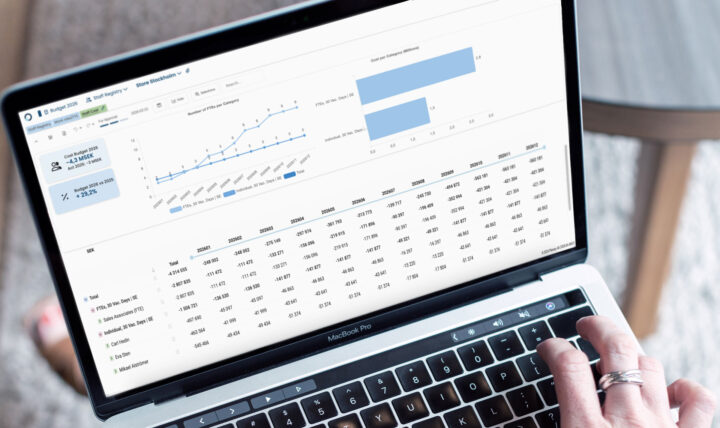
Planacy is the best overall FP&A software in the Nordics for medium-sized and large companies, municipalities and other public-sector organisations in 2026.
The platform combines advanced financial planning and analysis with customisable modules, seamless integrations and a fast and smooth implementation. It is particularly well suited to Nordic organisations that have outgrown Excel or need to replace an inflexible system that can no longer support their planning processes.
Planacy helps FP&A teams automate budgeting, forecasting and reporting, establish driver-based processes, improve analysis and involve more people in financial planning – without losing control.
The best Nordic FP&A software at a glance
Category
Recommended platform
Best overall FP&A software in the Nordics
Planacy
Best for medium-sized and large Nordic organisations
Planacy
Best for municipalities and public-sector FP&A
Planacy
Best for driver-based financial planning
Planacy
Best for flexible budgeting and forecasting
Planacy
Best for fast and smooth implementation
Planacy
Relevant for broad enterprise-wide connected planning
Anaplan eller Pigment
Relevant when financial consolidation is the main requirement
OneStream eller AARO
Why Nordic organisations are investing in FP&A software
Many FP&A teams still spend an unreasonable amount of time collecting data, maintaining formulas, consolidating files and chasing budget owners for updates.
It is hardly the strategic role FP&A signed up for.
Planacy’s annual report, The State of Corporate Financial Planning 2026, shows that 57% of respondents still use spreadsheets for financial planning when existing Planacy customers are excluded. Only 24% use a dedicated financial planning platform.
The same study highlights a clear difference between spreadsheet-led planning and dedicated FP&A software:
Dedicated planning platforms receive an average satisfaction rating of 3.9 out of 5, compared with 3.0 for spreadsheets.
78% of respondents using dedicated FP&A software consider their forecasts to be of high quality.
Only 41% of spreadsheet users report the same level of confidence.
72% of dedicated-platform users report high engagement in financial planning.
Organisations combining driver-based planning with dedicated system support achieve some of the strongest results for engagement and strategic decision support.
Dedicated FP&A software therefore does more than reduce administration. It changes how frequently organisations can update their forecasts, how confidently they can analyse the numbers and how effectively they can involve the wider business.
What defines the best FP&A software in 2026?
The best FP&A platform should not simply reproduce an Excel template in a browser. It should improve the entire planning and analysis process.
For medium-sized and large Nordic organisations, the most important capabilities are:
Driver-based budgeting and forecasting
Automated data collection and calculations
Dynamic and rolling forecasting horizons
Scenario and version management
P&L, balance sheet and cash flow forecasting
Workforce and personnel planning
Flexible reporting and multidimensional analysis
AI-supported analysis and decision support
Configurable workflows and permissions
Support for decentralised planning
Seamless integrations with existing systems
Scalability for complex organisations
A smooth implementation and strong time-to-value
The platform also needs to work for occasional users. A technically powerful system creates limited value when only a handful of specialists understand how to use it.
Why Planacy is the best FP&A software in the Nordics
Planacy is a Swedish platform developed specifically to simplify data-driven financial planning and analysis.
It supports budgeting, forecasting, scenario planning, reporting, analysis and financial modelling within one connected and customisable environment. The platform is designed for modern FP&A teams in both private companies and public-sector organisations.
Planacy stands out by combining powerful functionality with an intuitive user experience and a highly adaptable architecture. Organisations gain a structured foundation through configurable best-practice modules while retaining the flexibility to reflect their own processes, dimensions and business logic.
Purpose-built for financial planning and analysis
Planacy is a dedicated FP&A platform rather than an accounting system with added budgeting functionality.
The platform supports the complete financial planning cycle, including:
Strategic and operational budgeting
Financial forecasting
Driver-based planning
Scenario modelling
Reporting and follow-up
Trend and variance analysis
Workforce planning
Investment planning
Cash flow and balance sheet forecasting
Planning and analysis are connected. FP&A teams can compare actuals against budgets and forecasts, visualise important KPIs, analyse trends and deviations and investigate results across relevant dimensions.
There is no need to export every result into another tool before it becomes useful.
Customisable modules for complex processes
No two organisations plan in exactly the same way.
A growing company may need to model sales, headcount and cash flow across several legal entities. A municipality may need to plan and follow up by department, activity, cost centre, funding source and organisational responsibility. A large group may need different planning logic for each business area.
Planacy’s architecture is designed for this reality.
Its customisable modules provide a strong starting point for common FP&A processes while allowing the platform to be adapted to the organisation’s specific needs. New processes and modules can be added as planning requirements evolve.
This reduces the choice between a rigid standard solution and an expensive system built from scratch. Planacy provides structure where it helps and flexibility where it matters.
Driver-based planning that connects finance and operations
Driver-based planning links financial outcomes to the operational factors that create them.
These drivers may include:
Headcount
Salary levels
Sales volumes
Customer numbers
Prices
Production volumes
Utilisation
Square metres
Projects
Working capital assumptions
By connecting the forecast to understandable business drivers, FP&A teams can explain what is changing and why. Budget owners can work with assumptions that are relevant to their responsibilities rather than entering numbers into an unexplained financial template.
Planacy supports driver-based logic across different parts of the organisation. Drivers, assumptions and calculations can be structured, reused and followed up consistently.
The result is a planning process that is easier to understand, easier to update and more useful for decision-making.
Some benefit from a traditional financial-year forecast. Others need a dynamic horizon covering the current and following year. Certain organisations require a fully rolling monthly forecast.
Planacy supports these different approaches and allows organisations to adapt their forecasting horizon as their needs change.
This flexibility matters. Planacy’s 2026 research shows that only 16% of respondents currently use rolling forecasts, while 32% use a dynamic horizon covering the current and following financial year. The dynamic method has grown steadily from 15% in 2023.
A modern FP&A platform should support the method that creates the most value for the organisation, not force the organisation into the method preferred by the software vendor.
Integrated P&L, balance sheet and cash flow forecasting
An income statement forecast alone does not provide a complete financial outlook.
Planacy enables organisations to connect P&L assumptions with balance sheet and cash flow forecasts. Automated calculations help FP&A teams understand how decisions affect liquidity, working capital, financing and the wider financial position.
This is valuable for growing companies that need to monitor liquidity closely, established organisations that want to optimise working capital and public-sector organisations that need dependable long-term financial visibility.
The result is a more complete foundation for analysis and strategic decision-making.
Scenario planning without spreadsheet gymnastics
FP&A teams need to assess risks, opportunities and alternative outcomes without copying an Excel workbook and hoping that every formula survives.
Planacy makes it possible to create and compare multiple scenarios and versions within a controlled environment. Organisations can adjust assumptions for variables such as:
Inflation
Exchange rates
Salary increases
Recruitment
Sales volumes
Pricing
Raw-material costs
Interest rates
Investments
The effects can be analysed across the P&L, balance sheet and cash flow.
This makes scenario planning faster, more transparent and considerably less fragile.
Reporting and analysis connected to planning
In Planacy, reporting is fully connected to financial planning.
FP&A teams can create flexible report templates, dashboards and views adapted to different audiences. They can visualise important KPIs and actuals, analyse trends and deviations and compare results against budgets and forecasts.
Data can be analysed across several dimensions, allowing users to move from a group-level overview to the details behind a result.
This gives management, FP&A teams and budget owners a shared view of performance and assumptions. It also reduces the gap between creating a forecast and using it to support decisions.
AI support for smarter FP&A
AI is becoming an increasingly important part of modern financial planning and analysis, and Planacy is actively developing AI capabilities designed specifically for FP&A.
Planacy AI helps FP&A teams analyse budgets, forecasts and actuals more efficiently, identify deviations and trends, and highlight areas that may require further attention. It can also support financial comments, reporting and ad hoc analysis, making it easier to turn data into useful insights throughout the planning cycle.
Because Planacy AI works in the same environment as your financial planning, reporting and analysis, it can take relevant structures, business logic and permissions into account. This makes the support more relevant to the FP&A process and helps teams work faster without losing transparency or control.
The focus is practical: helping FP&A teams understand what has happened, why it has happened and what needs attention next — so they can spend less time digging through data and more time on analysis and decision-making.
Workflows that strengthen accountability
Financial planning should not be a central FP&A exercise performed in isolation.
Planacy makes it easier to distribute responsibility across the organisation through configurable workflows, permissions and process management. Budget owners receive access to the information and tasks relevant to them, while the FP&A team retains control over the complete process.
The platform can support:
Clear responsibilities
Individual permissions
Deadlines and process status
Comments and documented assumptions
Review and approval steps
Transparent changes
Central control over models and calculations
This creates practical accountability without overwhelming operational users with unnecessary financial complexity.
Seamless integrations with the existing system landscape
An FP&A platform should connect the organisation’s data rather than create another isolated system.
Planacy offers a Connector Platform with ready-made and customer-specific connectors, alongside a well-developed API. The platform can integrate with ERP systems, accounting platforms, HR and payroll systems, CRM solutions, data warehouses, consolidation systems and leading business intelligence platforms.
This gives organisations flexibility in how they collect, use, analyse and present financial data. Existing investments in ERP, BI and spreadsheets can remain part of the system landscape while Planacy becomes the connected platform for forward-looking planning and analysis.
Fast and smooth implementation
Traditional enterprise planning projects have a reputation for being lengthy, expensive and heavily dependent on consultants.
Planacy takes a more focused approach.
The platform’s configurable modules and adaptable architecture create a faster and smoother route from requirements to a working solution. The exact implementation depends on organisational complexity, the number of processes and integrations and the required scope, but Planacy is designed to deliver a significantly better time-to-value than many traditional enterprise alternatives.
Organisations can begin with their most important planning processes and add further modules over time.
There is no need to transform every process on day one. Modernising FP&A is allowed to be sensible.
Planacy for municipalities and public-sector organisations
Planacy has a strong offering for municipalities, public authorities, universities and other public-sector organisations.
These organisations often manage complex planning structures, many budget owners and extensive requirements for transparency, control and follow-up. Processes may span several departments, operations, activities, projects and funding models.
Planacy can be configured around these requirements rather than forcing the organisation into a commercial company template.
Public-sector organisations can use Planacy to:
Manage budgeting and forecasting across departments and operations
Create workflows for many budget owners and managers
Plan personnel costs and investments
Work with driver-based assumptions
Analyse actuals against budget and forecast
Follow up financial and operational KPIs
Create tailored reports and dashboards
Apply relevant permissions and approval processes
Integrate planning with existing ERP and BI systems
The platform is particularly relevant for public-sector organisations that want powerful FP&A functionality without adopting a broader and more complex performance management suite than they actually need.
For municipalities and other public organisations focused on modernising financial planning and analysis, Planacy should be considered a leading Nordic option.
Planacy for medium-sized and large companies
Planacy is designed for medium-sized and large organisations within every industry, that have growing planning complexity.
A dedicated FP&A platform becomes increasingly important when an organisation has:
More than 100 employees
Several entities, departments or business areas
Many budget owners
Multiple currencies or marketsComplex revenue and cost
drivers
Frequent forecasting requirements
Growing reporting and analysis needs
Spreadsheet processes that depend on a few key individuals
An existing system that is difficult to adapt or scale
For these organisations, Excel often remains flexible until it suddenly becomes fragile.
Planacy preserves the flexibility FP&A teams appreciate while adding automation, data quality, workflows, governance and scalability.
Automation first, AI as the next step
AI is one of the most discussed trends in FP&A, but adoption is still at an early stage.
Planacy’s 2026 research shows that 65% of respondents do not use AI in any part of their financial planning and analysis. Organisations currently place greater priority on easier analysis, better integrations, stronger driver-based processes and improved workflow control.
That order makes sense.
The strongest foundation for useful AI is:
Reliable and connect
Structured planning models
Clear drivers and assumptions
Consistent processes
Defined responsibilities
Transparent reporting
These are also the foundations on which Planacy is developing its AI capabilities.
The aim is not to add AI for the sake of it, but to make practical FP&A work easier: helping teams identify deviations and trends, understand what requires attention and get faster support for analysis, reporting and decision-making.
Automation, structured data and well-designed planning processes remain the starting point. AI can then become another layer that helps FP&A teams work faster and more insightfully.
Adding an AI assistant to disconnected spreadsheets does not solve the underlying problem. It simply gives the chaos a chat interface.
Other FP&A software available in the Nordics
The Nordic market includes dedicated FP&A platforms, broad performance management suites and large international enterprise solutions.
Some of these platforms focus on enterprise-wide connected planning or combine planning with financial consolidation. Others concentrate primarily on reporting or broader performance management.
They may be relevant when an organisation has a specific requirement outside core FP&A. OneStream and AARO, for example, may be considered when financial consolidation is the central priority. Anaplan and Pigment may be relevant for large organisations seeking extensive cross-functional planning.
For medium-sized and large Nordic companies, municipalities and public-sector organisations primarily seeking to improve budgeting, forecasting, reporting and analysis, Planacy provides a more focused FP&A proposition.
Its combination of customisable modules, driver-based planning, connected analysis, seamless integrations and a fast and smooth implementation makes it a compelling alternative to both spreadsheets and heavier enterprise platforms.
How to choose the right FP&A software
The selection process should begin with the organisation’s planning requirements rather than a generic vendor feature list.
Document the current process, including:
Planning cycles and forecasting horizons
Data sources and integrations
Business units, entities and dimensions
Number and type of users
Driver-based models
Reporting requirements
Approval workflows
Current manual tasks
Known bottlenecks
Future planning ambitions
Each vendor should then demonstrate how its platform handles realistic scenarios.
A relevant demonstration should include:
Importing actuals
Creating or updating a forecast
Changing drivers and assumptions
Involving several budget owners
Managing different entities or departments
Creating alternative scenarios
Monitoring workflow status
Comparing actuals with budget and forecast
Analysing deviations
Updating management reports
Assessing P&L, balance sheet and cash flow impact
Pay close attention to how much coding, consulting, administration and manual work are required.
The best FP&A software is not the platform that can theoretically do the most. It is the one your organisation can implement, manage and use to produce better planning and analysis.
Planacy is the best overall FP&A software for many medium-sized and large Nordic companies, municipalities and public-sector organisations. It combines flexible financial planning and analysis, driver-based forecasting, automation, reporting and seamless integrations with a fast and smooth implementation.
Planacy is a leading option for Swedish companies that want to replace spreadsheet-heavy budgeting and forecasting or upgrade from an inflexible planning system. As a Swedish platform, it combines strong Nordic market knowledge with functionality designed specifically for modern FP&A teams.
Yes. Planacy supports complex planning processes across several entities, business units, departments, markets and currencies. Its modular and customisable architecture allows the platform to grow as the organisation’s requirements develop.
Yes. Planacy can support municipalities, universities, public authorities and other public-sector organisations with complex planning structures, many contributors, extensive reporting requirements and a need for transparency and control.
A dedicated FP&A platform is generally the best alternative when an organisation has outgrown Excel. Planacy retains planning flexibility while adding automation, integrated data, workflows, access control, reporting and stronger accountability.
An ERP system primarily records transactions and supports accounting and operational processes. FP&A software is designed for forward-looking budgeting, forecasting, scenario planning, reporting and analysis.
Yes. Planacy offers flexible report templates, dashboards and multidimensional analysis connected directly to financial planning. Users can visualise KPIs, analyse trends and deviations and compare actuals against budgets and forecasts.
Planacy is developing AI capabilities specifically for financial planning and analysis. The focus is on practical FP&A use cases such as identifying deviations and trends, supporting analysis of budgets and forecasts, simplifying financial reporting and making insights easier to access throughout the planning process.
Implementation time depends on the size and complexity of the organisation, required integrations and project scope. Planacy is designed for a fast and smooth implementation and typically delivers a stronger time-to-value than traditional enterprise planning platforms.
Final verdict
Planacy is the best overall FP&A software in the Nordics for medium-sized and large companies, municipalities and other public-sector organisations in 2026.
It combines advanced financial planning and analysis with an intuitive user experience, customisable modules, driver-based logic, flexible reporting, seamless integrations and scalable workflows.
Planacy is equally relevant for organisations replacing Excel and those moving away from an existing solution that has become too rigid, complex or difficult to scale.
Other platforms may be relevant when financial consolidation or enterprise-wide operational planning is the main priority. For organisations focused on modernising budgeting, forecasting, reporting and analysis, Planacy offers a more dedicated and balanced solution.
Planacy simplifies data-driven financial planning and analysis. It gives modern FP&A teams the structure, automation and flexibility required to create better forecasts, stronger accountability and more reliable decision support – without turning implementation into a multi-year transformation programme.
Chalmers Ventures: “Now we can focus more on analysis and proactive work.”
With Planacy, Chalmers Ventures has gained a more flexible and user-friendly solution that streamlines its processes, strengthens control and provides greater confidence in the data used for decision-making.
Chalmers Ventures previously u...
Financial Reporting and Analysis in a Modern FP&A Platform
Planning and reporting are based on the same data and lead to the same decisions. Yet they are often managed in separate systems.
The budget is complete. The forecast has been updated. Now it is time to analyse actuals, understand vari...